Latest News

Latest News

New Portal Unites Campus STEM Network

Professor Daniela Barile, right, works with food science major Tian Tian to better understand the chemical and biological properties of bovine milk. (Gregory Urquiaga/UC Davis)


A new portal has opened to connect faculty, staff, students and the greater community to UC Davis STEM programs.

Developed by the STEM Strategies group in the Office of the Provost, the portal is designed to help students discover opportunities to engage in STEM (science, technology, engineering and math) at UC Davis.

Protein-Trapped Sugar Compounds Nourish Infant Gut Microbes

A new study shows that the sugar part of a sugar-protein milk compound nourishes beneficial bacteria in babies’ intestines. (ThinkStock image)


UC Davis researchers have shown that an enzyme produced by beneficial microbes in babies’ intestines is able to harvest specific sugar compounds from human breast-milk and cow’s milk. The discovery identifies the sugars — rather than associated protein compounds — as the key to nourishing those important, health-promoting microbes.

Barile Lab Graduate Students win 1st place and 3rd place at the The Sixth Annual Graduate Student Research Poster Competition

Fourteen graduate students from the Departments of Food Science and Technology, and Viticulture and Enology participated in the competition on December 10, 2015. Joshua Cohen and Randall Robinson were the first and third place winners, respectively. Josh’s poster was about a new Pilot scale isolation method for bioactive oligosaccharides from whey permeate. Randall presented his work in developing a novel, high-throughput method of oligosaccharide analysis by mass spectrometry.

Barile’s lab member wins 3rd place at RMI poster competition

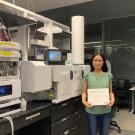
Tian is a fourth year Ph.D. candidate in the Barile Lab. Originally from China, she joined UC Davis after obtaining her bachelor degree in Food Science and Technology from Jiangnan University. Her research interests are to understand the relationship between the chemical structure and biological properties of food components, especially the activity of functional carbohydrates as prebiotics, and to develop the efficient separation method for isolating the identified carbohydrates from complex food matrices.

Breast milk reveals clues for health

An interdisciplinary team is decoding the mysteries of human breast milk, figuring out what makes it so good for babies — and hoping to capture that goodness to help improve other people’s health, say, by boosting immunity in children in the developing world, and in cancer patients and the elderly.

Meet the New Shields Chair: Dr. David Mills

“The endowment secures infinite dairy research at UC Davis. As the fund’s market value continues to grow, its earnings allow for the Chair to invest in students, faculty and research programs, all designed to advance California’s position in the global dairy industry,” says Mills.

Dairy Research Institute Grant Supports Innovative Work by FFHI Researchers

Foods for Health Institute researchers will measure the effects of complex sugars from cow milk to improve the function of the gastrointestinal system. They will analyze valuable molecules in whey permeate – a dairy-industry byproduct. As part of a research grant funded by the Dairy Research Institute, Foods for Health Institute researchers will be investigating the effects of feeding different doses of bovine milk oligosaccharides (BMOs, or sugars from cow’s milk) for the purpose of modifying the gastrointestinal function in healthy people. The grant includes the collaborative work of Dr.

Congrats to Dave Dallas, Kinsella Prize winner who has helped uncover secrets of human milk

Building on interdisciplinary studies conducted at UC Davis on the composition and protective qualities of human breast milk, Dallas characterized N-linked glycans, a component of human breast milk that is associated with beneficial health effects, but has undetermined functions. Dallas’ doctoral work identified 500 novel peptides, compounds never before identified in human milk.

Wheys and Means: The New Model for Human Diet and Health

The goal of life sciences is to build an integrative view of diet and health and to apply this knowledge to improving health and preventing disease. To this end, it will be necessary to understand the targets in individual humans on which diet acts to actually improve their health and lower their risk of future disease. How could such targets be found?

Original article here: https://www.preparedfoods.com/articles/110238-wheys-and-means-the-new-m…

Dr. Juliana Nobrega Brings the Milk Processing Lab to Life

New project scientist working at the lab

Dr. Nobrega joined the Foods for Health Institute in September 2012, where she is currently working in the Advanced Milk Processing Lab. She is engaged in several projects under the direction of FFHI researchers Dr. David Mills and Dr. Daniela Barile, including the multi-million dollar Gates Foundation Grant on infant nutrition.

R.I.S.E: Protecting the Fragile Intestine

Several researchers from the Foods for Health Institute, and others were awarded a prestigious Research Investments in the Sciences and Engineering (R.I.S.E.) grant from the UC Davis Office of Research. The project “Protecting the Fragile Intestine: Integrating Microbiota and Mucosal Health” examines the important role of the intestine in promoting overall health.

The Barile lab will be in charge of isolating and characterizing the novel oligosaccharides for the functional studies

FST Professors funded by the Gates Foundation

Researchers at the University of California, Davis, will join in an international research effort to develop new ways to diagnose, treat and prevent malnutrition in infants and children around the world.